Master the game
Everything you need to know, from cards and bidding to scoring and special rules.
Quick Start
Learn the basics of Slovenian Tarok step by step
The Deck
Tarok uses a unique 54-card deck — larger than a standard playing deck.
Deck Composition
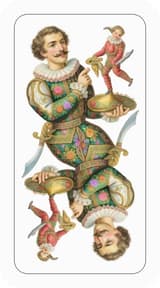
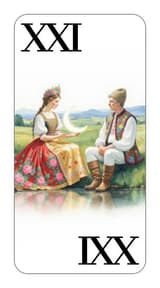
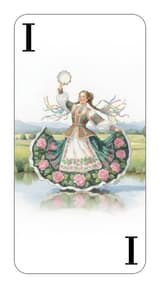
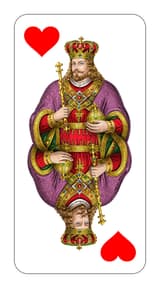
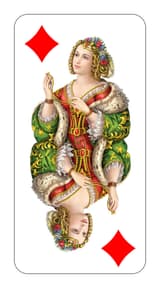
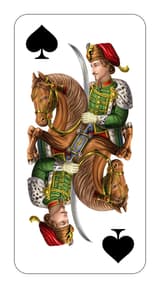
The 4 suits are Hearts, Diamonds, Spades, and Clubs — each with 8 cards (King, Queen, Knight, Jack + 4 numeral cards).
Key Cards
These cards are worth the most points (5 each). Trula (Pagat, Mond, Škis) has a special rule — if all three appear in the same trick, the Pagat beats the Škis. Kings are called to choose a partner in 4-player games.
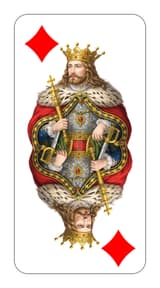
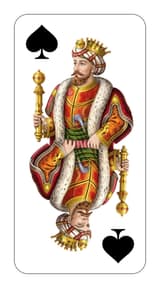
Card Values & Counting
Every card has a point value. The total across the deck is 70 points.
| Card | Points |
|---|---|
| Kings | 5 |
| Pagat (I), Mond (XXI), Škis | 5 |
| Queens | 4 |
| Knights | 3 |
| Jacks | 2 |
| All other cards | 1 |
How to count points
Cards are grouped into batches of 3. For each batch, add up card values and subtract 2. If 1 or 2 cards remain, subtract 1 from their sum.
Worked example
Batch: King (5) + Queen (4) + Tarok VII (1) = 10 − 2 = 8 points.
Another batch: Three 1-point cards = 3 − 2 = 1 point.
The maximum total is 70 points. You need 36+ to win a normal game.
How a Game Round Works
Each game round consists of eight phases that follow in a set order.
Dealing
Each player receives 16 cards (3-player) or 12 cards (4-player). 6 cards go to the talon.
Bidding
Players bid on game types in ascending order of value. Each player either bids or passes.
Talon Selection
In game modes with a talon, the declarer chooses a portion of the talon to pick up.
King Calling
In 4-player normal games (Tri/Dva/Ena), the declarer calls a king — the holder of that king becomes their secret partner. Only applies in 4-player games.
Stashing
The declarer exchanges cards from their hand, putting unwanted cards into their point pile (cannot stash Pagat, Mond, Škis, or Kings).
Predictions
Players may announce bonuses: Trula, Kralji, Pagat Ultimo, Kralj Ultimo, Valat. Opponents may counter with Kontra.
Playing
Players play tricks in clockwise order. Must follow suit; if unable, must play a tarok; if no taroks, may play any card.
Results
Points are counted in batches of three. Scores are calculated based on game mode, difference from 35, and announced bonuses.
In most home games, phases 4–6 (king calling, stashing, predictions) happen quickly. The core gameplay is bidding and playing tricks.
Trick Rules
Tricks are the heart of the game. Understanding these rules is essential.
The 4 Rules of Tricks
Follow suit:
You must play a card of the same suit as the first card in the trick if you have one.
Tarok:
If you cannot follow suit, you must play a tarok if you have one.
Free play:
If you have neither the required suit nor any taroki, you may play any card.
Highest wins:
The highest tarok in the trick wins. If no taroki were played, the highest card of the led suit wins.
Example Trick
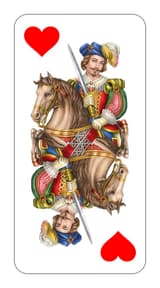
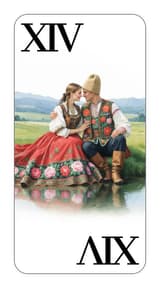
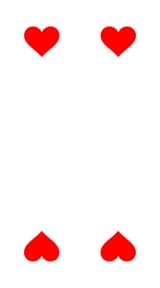
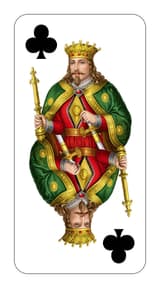
Player 1 leads with the King of Hearts (5 pts). Player 2 follows suit with the Knight (3 pts). Player 3 has no Hearts, so they must play a tarok — Tarok XIV wins the trick! Player 4 follows suit with 4 of Hearts (1 pt).
Bidding & Game Types
Before play begins, players bid to determine who will be the declarer and what game type is played.
How bidding works
Starting from the player to the dealer's right (forehand), each player either bids or passes. Once you pass, you're out. The last remaining bidder becomes the declarer. Forehand — the player to the dealer's right — has the highest priority and can match a bid to claim it.
Players with higher priority (closer to forehand) can match a bid to overcall, while lower-priority players must bid higher to stay in.
Contracts are bid in a fixed order from lowest (Klop) to highest (Valat) — see the Game Modes tab for the full bidding ladder.
Game types
Klop
0 ptsEveryone plays alone, trying to take as few points as possible.
Tri
10 ptsPick 3 cards from the talon. Call a king for a partner. Win 36+ points.
Dva
20 ptsPick 2 cards from the talon. Call a king for a partner. Win 36+ points.
Ena
30 ptsPick 1 card from the talon. Call a king for a partner. Win 36+ points.
Solo tri
40 ptsPlay solo. Pick 3 cards from the talon. Win 36+ points.
Solo dva
50 ptsPlay solo. Pick 2 cards from the talon. Win 36+ points.
Solo ena
60 ptsPlay solo. Pick 1 card from the talon. Win 36+ points.
Berač
70 ptsPlay solo. You must not win a single trick. Forced beating applies.
Solo brez
80 ptsPlay solo without the talon. Talon points go to opponents.
Odprti berač
90 ptsSame as Berač, but you play with cards face-up on the table.
Barvni valat
125 ptsWin all tricks. Taroki don't beat suit cards — strict suit following only.
Valat
500 ptsWin all tricks. Normal tarok rules apply. Worth 500 points.
Scoring Basics
Scores are calculated based on the contract, card point difference, and any bonuses.
The basic formula
For normal games (Tri, Dva, Ena) and solo games (Solo tri, Solo dva, Solo ena), the score is the game worth plus the difference from 35, multiplied by any kontra chain.
Worked example
You play Dva (worth 20 pts) and collect 43 card points. The difference is 43 − 35 = 8, rounded to 10.
Score = 20 (Dva) + 10 (difference) = 30 points won
Bonuses at a glance
Bonuses are scored independently of the main game and can be announced for double value:
Trula
+10 / +20 announcedCollect all 3 Trula cards (Pagat, Mond, Škis)
All Kings
+10 / +20 announcedCollect all 4 Kings
Pagat Ultimo
+25 / +50 announcedWin the last trick with Pagat (I)
Valat
+500Win all tricks
Overview
The basics of Slovenian Tarok
What is Tarok?
Tarok (also known as Tarock or Slovenian Tarok) is a traditional trick-taking card game for 3 or 4 players. It uses a special 54-card deck consisting of 22 taroki and 32 suit cards across four suits: Hearts, Diamonds, Spades, and Clubs.
The goal varies by game mode — in most contracts, the declarer tries to collect more than 35 card points out of 70 total. In negative games like Klop or Berač, the objective is reversed.
Tarok is beloved across Central Europe, with Slovenian Tarok being one of the most popular and strategically rich variants.
Game Flow
A standard round goes through these phases in order
Dealing
Each player receives 16 cards (3-player) or 12 cards (4-player). 6 cards go to the talon.
Bidding
Players bid on game types in ascending order of value. Each player either bids or passes.
Talon Selection
In game modes with a talon, the declarer chooses a portion of the talon to pick up.
King Calling
In 4-player normal games (Tri/Dva/Ena), the declarer calls a king — the holder of that king becomes their secret partner. Only applies in 4-player games.
Stashing
The declarer exchanges cards from their hand, putting unwanted cards into their point pile (cannot stash Pagat, Mond, Škis, or Kings).
Predictions
Players may announce bonuses: Trula, Kralji, Pagat Ultimo, Kralj Ultimo, Valat. Opponents may counter with Kontra.
Playing
Players play tricks in clockwise order. Must follow suit; if unable, must play a tarok; if no taroks, may play any card.
Results
Points are counted in batches of three. Scores are calculated based on game mode, difference from 35, and announced bonuses.
Basic Trick Rules
Follow suit:
You must play a card of the same suit as the first card in the trick if you have one.
Tarok:
If you cannot follow suit, you must play a tarok if you have one.
Free play:
If you have neither the required suit nor any taroki, you may play any card.
Highest wins:
The highest tarok in the trick wins. If no taroki were played, the highest card of the led suit wins.
Trick leader:
The winner of each trick leads the next one.
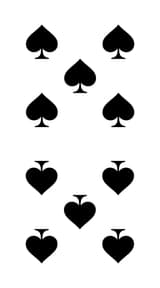
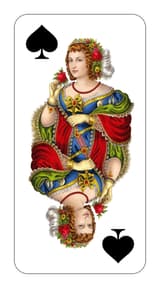
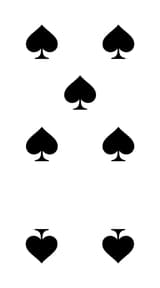
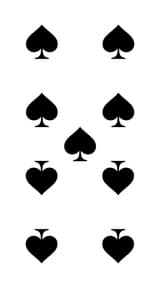
Player 1 leads Pik 10. Everyone follows suit. Pik Dama (Queen) is the highest card of the led suit, so Player 2 wins the trick and leads next.
Who Leads First?
In normal contracts (Tri through Solo Ena), the player to the dealer's right (forehand) always leads the first trick, regardless of who is the declarer. In higher contracts (Berač and above), the declarer leads the first trick.
King Calling
In 4-player normal games (Tri, Dva, Ena), the declarer names a suit. The holder of the king of that suit becomes the declarer's secret partner — but doesn't reveal themselves. The partnerships often aren't discovered until late in the hand.
It is legal to call a king you already hold. In this case you play alone against three opponents, but they won't realize it at first. This is generally not a strong strategy — declaring a solo contract brings 30 more base points.
If the called king happens to be in the talon, the declarer plays alone. If the king is in the unchosen part of the talon, the declarer can win those cards by picking up the part containing the called king and winning a trick with it.
Glossary of Tarok Terms
Common Slovenian terms you'll hear at the table
Talon
The six face-down cards set aside during the deal. Depending on the contract, the declarer exchanges some of them.
Štih
A trick — one card played by each player. The winner collects the cards and leads the next trick.
Klicač
The declarer — the player who won the bidding and plays the chosen contract.
Predrok
Forehand — the player to the dealer's right. Has the highest bidding priority and leads the first trick in normal games.
Trula
The three top taroki: Pagat (I), Mond (XXI), and Škis. Each is worth 5 points; collecting all three is a bonus.
Platelci
The 32 suit cards (Hearts, Diamonds, Spades, Clubs), as opposed to the 22 taroki.
Kontra
A doubling of the game's or a bonus's score, declared by the opposing side. Can be raised to Rekontra, Subkontra, and Mordkontra.
Radelc
A bonus marker all players receive after a Klop, a Berač or higher contract, or any Valat. It doubles your next declared contract's score and is cancelled when you win.
Renons
A rule violation, such as failing to follow suit — penalised with the full value of the game.
Game Modes
All contracts and how they're played
Bidding Ladder
All contracts in bidding order, from lowest to highest
Klop and Tri cannot be bid — they are available only to forehand when all other players pass. During bidding you may only overcall with a higher contract, or match one if you have higher priority (closer to forehand).
Normal Games
Tri
10 ptsDeclarer picks one half of the 6-card talon (3 cards) and exchanges cards from their hand.
Dva
20 ptsDeclarer picks one third of the talon (2 cards) and exchanges cards.
Ena
30 ptsDeclarer picks one sixth of the talon (1 card) and exchanges one card.
Solo Games
Solo tri
40 ptsDeclarer plays alone against all others. Picks 3 cards from the talon.
Solo dva
50 ptsDeclarer plays alone. Picks 2 cards from the talon.
Solo ena
60 ptsDeclarer plays alone. Picks 1 card from the talon.
Solo brez
80 ptsDeclarer plays alone without looking at the talon. Talon points go to the opposing team.
Negative Games
Klop
0 ptsEveryone plays individually, trying to win as few points as possible. After each of the first six tricks, one talon card is turned face up and given to the trick winner. Zero tricks scores +70, more than 35 points scores −70, otherwise you score minus the points you took.
Berač
70 ptsDeclarer must not win a single trick. Cards are played with forced beating — you must play a higher card if you can.
Odprti berač
90 ptsSame as Berač, but declarer plays with cards face-up on the table for everyone to see.
Special Games
Barvni valat
125 ptsDeclarer must win all tricks. Taroki do not beat suit cards — strict suit following only. The highest card in the led suit wins.
Valat
500 ptsDeclarer must win every single trick. Normal tarok rules apply. Worth 500 points — the ultimate contract.
Scoring
How card points and bonuses are counted
Card Point Values
Each card has a point value used for scoring. Points are counted in batches of three.
| Card | Points |
|---|---|
| Kings | 5 |
| Queens | 4 |
| Knights | 3 |
| Jacks | 2 |
| Pagat (I), Mond (XXI), Škis | 5 |
| All other cards | 1 |
Counting Points — Batch of Three
After all tricks are played, collected cards are grouped into batches of three. For each batch, sum the individual point values and subtract 2. If there is a remainder of 1 or 2 cards that don't form a full batch, subtract 1 from their sum.
Example batch
5 + 4 + 1 − 2 = 8 points
The maximum possible score is 70 points. The threshold to win a normal game is 36 points (more than half of 70).
Normal Game Scoring
For game modes Tri, Dva, Ena, Solo tri, Solo dva, and Solo ena
The difference is calculated as the declarer's card points minus 35, rounded to the nearest 5.
If the declarer scores 36+, they win. The score is positive for the playing team and negative for the opposing team (and vice versa on a loss).
Predictions & Bonuses
Announcements made before play that affect scoring
| Bonus | Unannounced | Announced | Failed |
|---|---|---|---|
| Trula | +10 | +20 | −20 |
| All Kings | +10 | +20 | −20 |
| Pagat Ultimo | +25 | +50 | −50 |
| King Ultimo | +10 | +20 | −20 |
| Valat | +250 | +500 | −500 |
| Captured Mond | −21 penalty to Mond player (−42 if Mondfang was announced) | ||
The game, Pagat Ultimo, King Ultimo, the Valat announcement, and Mondfang each have their own independent kontra chain (×2, ×4, ×8, ×16). Trula and All Kings announcements are flat ±20 and cannot be kontra'd. If Valat is announced and achieved, all other scoring is replaced by the Valat score.
Direction matters: if the defenders sweep all three Trula cards or all four Kings unannounced, the declarer scores −10 for that line. Likewise, an unannounced Valat scores +250 for the declarer's side — or −250 if the defenders take every trick.
Kontra Chain
During the announcement phase, the defending side may double the score for the game or a kontrable bonus by saying "Kontra". The declaring side can then double again, and so on.
Each level doubles the multiplier. The game, Pagat Ultimo, King Ultimo, the Valat announcement, and Mondfang are kontra'd independently — you specify exactly what you're doubling. Trula and All Kings cannot be kontra'd.
Radelci (Bonus Rounds)
Score multipliers that reward active play
Radelci are bonus markers given to all four players after certain events. When a declarer who holds radelci plays a contract, that hand's score is doubled. The radelc is cancelled only if the declarer wins — on a loss the score is still doubled but the radelc stays.
- A round of Klop is played
- A contract of Berač or higher is played
- Any kind of Valat is won or lost
At the end of the session, 100 points are subtracted from each player's score for every uncancelled radelc. This encourages players to actively declare contracts rather than always passing.
Worked Example — Four Hands
How a score sheet develops over a few hands. Only the declarer's side writes a score.
| Hand | Ana | Boris | Cilka | David |
|---|---|---|---|---|
| 1 | +40 | — | +40 | — |
| 2 | — | +70 | — | — |
| 3 | — | — | +150 | — |
| 4 | −140 | — | — | −140 |
- Cilka plays Ena and calls Ana's king. They win by 10, so both write 30 (Ena) + 10 (difference) = +40.
- Boris plays Berač and wins: +70. Because a Berač was played, every player receives a radelc.
- Cilka plays Solo tri with an uncancelled radelc, announces Trula, and wins by 15: (40 + 15 + 20) × 2 = +150. One of her radelci is cancelled.
- David plays Dva, calls Ana, and announces Pagat Ultimo. They lose both — with his radelc still active: −(20 + 50) × 2 = −140 each. The radelc stays.
Cards
The Tarok deck's 54 cards at a glance
Taroki
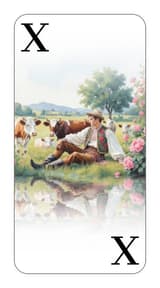
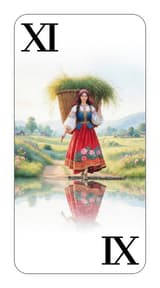
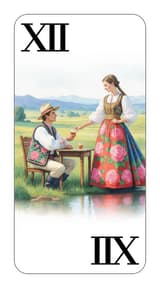
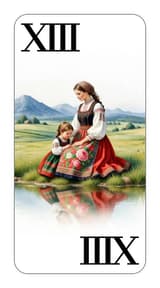
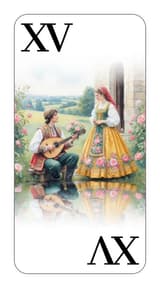
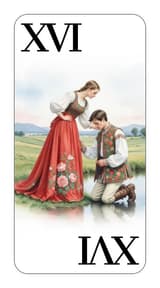
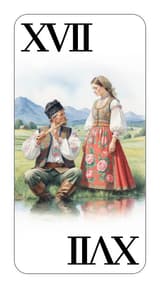
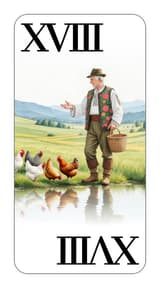
22 taroki — always beat suit cards
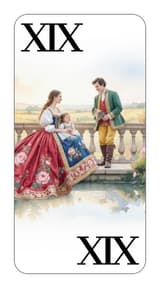
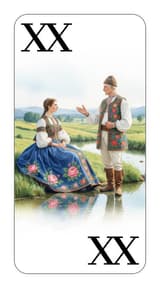
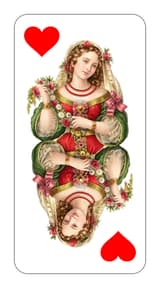
Srce (Hearts)
Red suit — numbered 1–4 + court cards


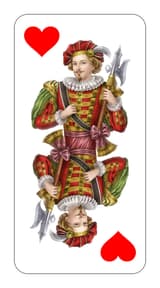
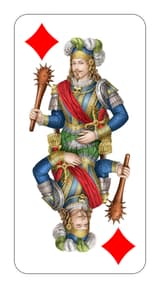
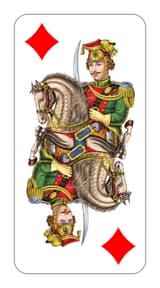
Kara (Diamonds)
Red suit — numbered 1–4 + court cards
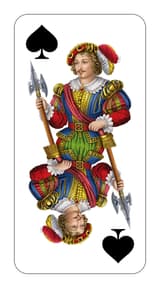
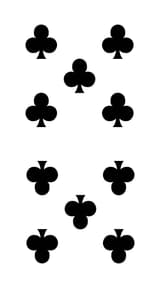
Pik (Spades)
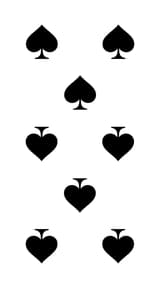
Black suit — numbered 7–10 + court cards
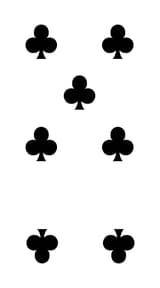
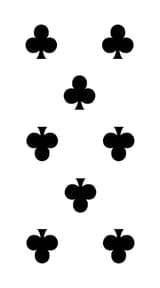
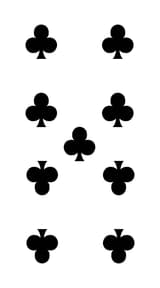
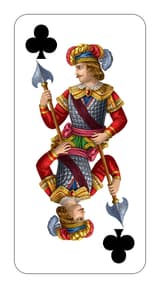
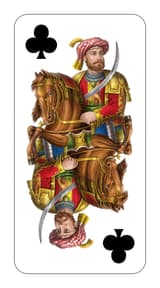
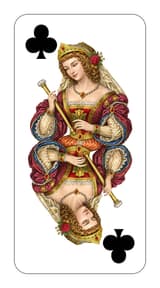
Križ (Clubs)
Black suit — numbered 7–10 + court cards
Special Rules
Trula, All Kings, Pagat ultimo, and more
If all three Trula cards — Škis, Mond (XXI), and Pagat (I) — are played to the same trick, the Pagat counts as the highest tarok and wins the trick. This is the only situation where the Škis does not win. The Captured Mond penalty still applies to the player who played the Mond.
All three Trula cards land in the same trick. Normally the Škis always wins, but in the Emperor Trick the lowly Pagat beats it and takes the trick.
If both Škis and Mond (XXI) have been played into the current trick, any player holding the Pagat (I) is forced to play it. When all three Trula cards are in the same trick, the Pagat beats the Škis — this is the only case where Škis does not win the trick.
In Klop, Berač, and Odprti berač, the Pagat cannot be played to lead a trick unless it is the player's only remaining card. This forces the Pagat to be the last card played.
In Klop, Berač, and Odprti berač, players must beat the currently highest card in the trick if they are able to. This means you cannot deliberately play a lower card when you hold one that could win. This applies both when following suit and when playing taroki.
In a negative game each player must beat the highest card in the trick if they can. Players 2 and 3 are forced to play higher taroki; Player 4 holds nothing above Tarok XIX, so a low card is allowed. Player 3 takes the trick — bad news in Klop!
In Barvni valat, the normal tarok rules are suspended. Taroki do not beat suit cards. Players must strictly follow the led suit. The highest card of the led suit wins each trick, regardless of any taroki played. The declarer must win all tricks under these rules.
After picking cards from the talon, the declarer must return the same number of cards from their hand to their point pile. The following cards cannot be stashed:
- Pagat (I)
- Mond (XXI)
- Škis
- Any King (Kralj)
Taroki may only be stashed if you have no suit cards available. Their point value counts toward the declarer's score.
If the Mond (XXI) is captured by the opposing side — the Škis takes the trick, or Pagat, Mond and Škis are all in the same trick and Pagat wins it — the player who played the Mond pays a −21 point penalty (−42 if Mondfang was announced). The same penalty applies if the declarer leaves Mond in the talon without taking it. If the called king is in the talon and the declarer wins a trick with that king, any remaining talon cards (including Mond) count as brought home and there is no Mondfang for that Mond. The penalty is personal to the Mond holder and doubles with each Mondfang kontra (radelci do not affect it).
All four players earn a radelc (bonus marker) whenever a Klop is played, a Berač or higher is played, or any Valat is won or lost. While you hold radelci, a contract you declare — or your result in a Klop — scores double. A radelc is cancelled only when you win — win a declared contract (or win a Klop) and one radelc is removed; if you lose, the hand still counts double but the radelc remains.
When all players have accumulated radelci and nobody wishes to bid, a round of Klop is played automatically.